New Springer Publication: The Customer Moment – How Social Commerce Is Reinventing the Customer Journey
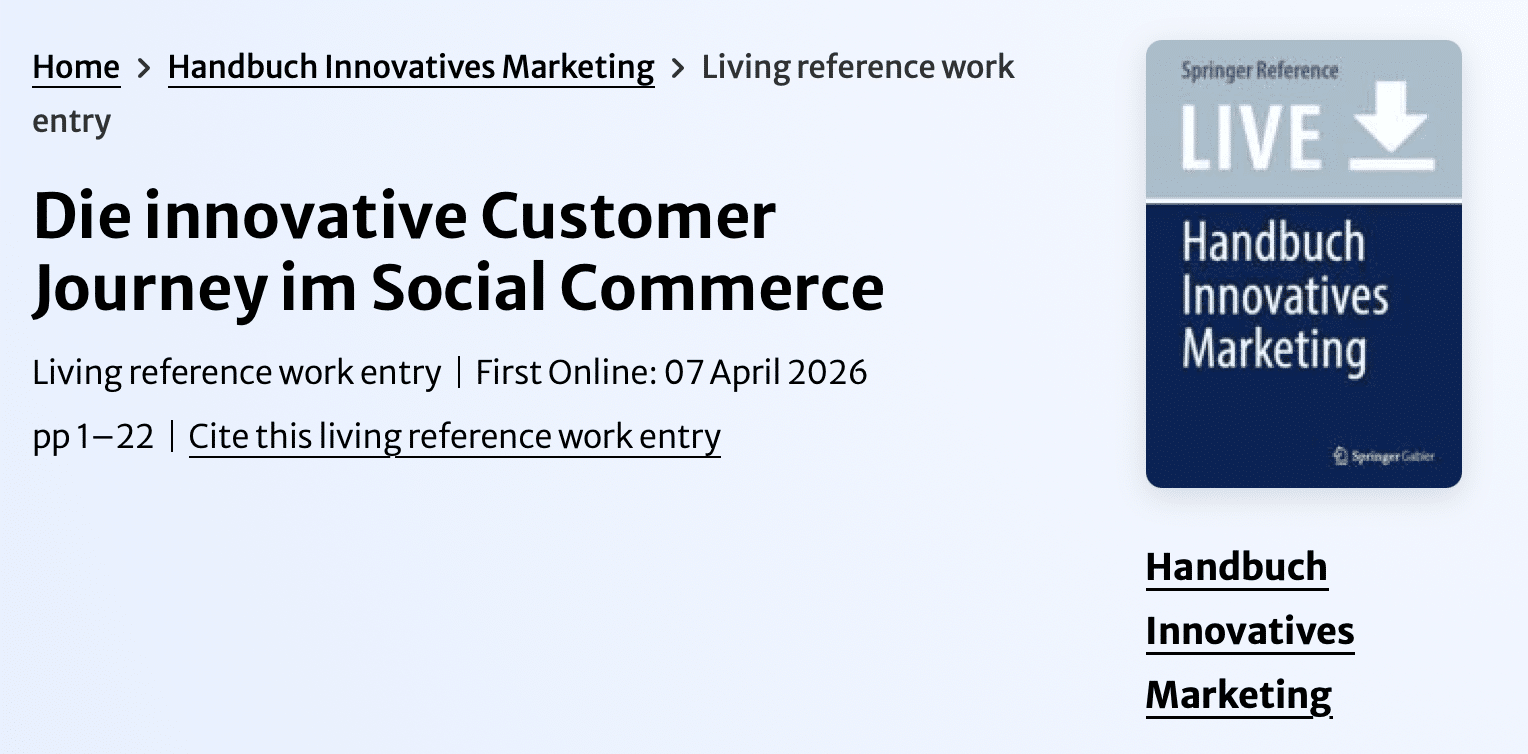
Abstract: Prof. Dr. Richard C. Geibel and Ulrich Arnold have published a new contribution with the renowned Springer publishing house: “Die innovative Customer Journey im Social Commerce” (The Innovative Customer Journey in Social Commerce). The article develops the concept of the “Customer Moment” – the condensed, impulse-driven purchase decision process that replaces classical multi-stage customer journey models. It analyses how algorithmic personalisation, in-app shopping and the creator economy are structurally transforming purchase decisions, and discusses regulatory and ethical challenges.
Important Facts
- New Springer publication by Prof. Dr. Richard C. Geibel (E-Commerce Institute Cologne / IU Internationale Hochschule) and Ulrich Arnold (GKV Informatik).
- Published in the “Handbuch Innovatives Marketing” (Handbook of Innovative Marketing) by Springer Fachmedien Wiesbaden (2026).
- Core concept: The “Customer Moment” – inspiration, evaluation and purchase occur simultaneously within a single platform-integrated instant.
- Social commerce reduces the customer journey from up to 100 touchpoints to often just a single step.
- 37% of consumers already purchase via Facebook, 28% via Instagram and 18% via TikTok (DHL E-Commerce Trend Report 2024).
- Market forecast: Social commerce will reach around €13 billion in Germany by 2030 – approximately 10% of the total e-commerce market.
- The article also addresses risks: data protection, youth protection, compulsive buying and social scoring.
From “Customer Seeks Product” to “Product Finds Customer”
The classic customer journey is complex: up to 100 touchpoints – from the advertising banner through landing page, shopping cart and checkout to the review – separate inspiration from purchase. At each of these points, businesses can lose customers. Social commerce addresses precisely this problem.
In their Springer publication, Geibel and Arnold show that TikTok, Instagram, YouTube and others have established an entirely new purchasing mechanism: the Customer Moment. Instead of actively searching for products, users discover them while casually scrolling – algorithmically personalised, contextually relevant, ready to purchase within seconds. Inspiration, evaluation and transaction converge in a single, platform-internal instant.
The Customer Moment refers to the impulsive, situational decision point at which users are immediately motivated to take action on the basis of algorithmically personalised content – without the need to switch between platforms or actively seek out information pathways.
— Prof. Dr. Richard C. Geibel & Ulrich Arnold, Springer 2026
Customer Journey vs. Customer Moment: A Comparison
| Feature | Traditional Customer Journey | Customer Moment |
| Primary goal | Considered purchase | Impulse / direct purchase |
| Number of touchpoints | Up to 100 | Minimal (often just 1) |
| Transaction location | External website / shop | Within the platform |
| Steps required | Multi-step (search, log in, pay) | Single-step (discover & buy) |
| Risk of losing customer | High (many friction points) | Low (seamless & convenient) |
| Psychological driver | Need, comparison, information | FOMO, convenience, entertainment |
Table: Geibel & Arnold, Springer 2026, own analysis E-Commerce Institute Cologne
AI, the Creator Economy and the Platforms of the Customer Moment
The Customer Moment is not accidental – it is the result of precise technological orchestration. Artificial intelligence analyses user behaviour, predicts purchase intent and delivers personalised content before a need is explicitly expressed. Creators and influencers take on the role of social proof: their recommendations feel more authentic than traditional advertising.
Practical examples from the publication include TikTok Shop (launched in Germany in March 2025, with over 14,000 brands and retailers by October 2025), the Meta–Amazon partnership for in-app purchases without platform switching, Snapchat x Nike for direct shoe purchases via QR code in a stadium, and OTTO and ABOUT YOU Live Shopping. Each of these confirms that the Customer Moment is becoming not a trend, but the standard.
Challenges: Data Protection, Youth Safety and Ethical Boundaries
Geibel and Arnold also examine the other side: the seamless purchase function and FOMO tactics (“Fear of Missing Out”) can lead to compulsive buying and overconsumption, particularly among younger users. Processing personal data for transactions is in tension with the anonymous nature of social media. The Digital Services Act (DSA) and the EU strategy “Better Internet for Kids” establish regulatory guardrails in this space.
The article advocates for responsible platform design – through spending limits, cool-down periods and transparent algorithms – rather than blanket social media bans for minors.
Academic Context
The contribution by Prof. Dr. Richard C. Geibel and Ulrich Arnold is part of the Handbook of Innovative Marketingpublished by Springer Fachmedien Wiesbaden and is now available online-first on SpringerLink. The article connects current scientific literature with empirical market observations and develops an analytical model for contextualising the Customer Moment – with implications for research, corporate strategy and regulation.
The research of the E-Commerce Institute Cologne demonstrates: social commerce is not merely a further development of e-commerce, but creates an entirely new, algorithmically structured market environment. Understanding the Customer Moment means understanding the future of digital retail.
Frequently Asked Questions (FAQ)
Question: What is the Customer Moment in social commerce?
Answer: The Customer Moment refers to the condensed instant in which product discovery, evaluation and purchase occur simultaneously on a single platform – triggered by algorithmically personalised content, without switching platforms and without laborious search processes.
Question: How does social commerce differ from traditional e-commerce?
Answer: While traditional e-commerce is based on a multi-stage customer journey with up to 100 touchpoints, social commerce condenses the entire purchase process into a single, platform-internal step. The model shifts from “customer seeks product” to “product finds customer”.
Question: Which platforms are shaping the Customer Moment in 2026?
Answer: TikTok Shop, Instagram Shopping, Amazon Live Shopping, OTTO Live Shopping and partnerships such as Meta x Amazon are among the leading implementations. According to the Springer publication, TikTok Shop in Germany had already activated over 14,000 brands and retailers by October 2025.
Question: What risks does social commerce bring?
Answer: Geibel and Arnold identify data protection conflicts, manipulative FOMO tactics, compulsive buying among young people and the risk of social scoring. Regulatory countermeasures such as the Digital Services Act (DSA) are establishing initial guardrails.
Question: How large will the social commerce market in Germany be by 2030?
Answer: According to forecasts in the Springer article, social commerce will generate around €13 billion in revenue in Germany by 2030 – equivalent to a market share of approximately 10% of the total German e-commerce market (total market: approx. €134 billion).
This article is based on the Springer publication: Geibel, R.C. & Arnold, U. (2026). Die innovative Customer Journey im Social Commerce. In: Schuster, G., Bornemeyer, C. (eds.), Handbuch Innovatives Marketing. Springer Fachmedien Wiesbaden. https://doi.org/10.1007/978-3-658-46709-8_19-1