CIP Updates
This page documents the progress of the project ZiBeKo – Target Group-Specific Needs Assessment and Communication, carried out as part of Community Innovative Care (CIP) within the DATIpilot programme of the German Federal Ministry for Research, Technology and Space (BMFTR). All updates are listed in reverse chronological order – the latest news always appears at the top.
07. October 2026
The 3rd funding call of the Community Innovative Pflege (CIP) is now open: project consortia from care practice, research and industry can submit their project outlines until 15 November 2026. The call is looking for transfer-oriented, technologically grounded innovation projects that bring digital assistive technologies where they create real impact – into care practice. Funding amounts to up to €300,000 per project, depending on format and topic.
Key Facts at a Glance
- Submission deadline: 15 November 2026, 23:59 – project outline by email to cip@innovativepflege.de
- Funding: up to €300,000 per project, depending on format and topic
- Project formats: Praxis-Sprint, Community-Sprint or F&E collaborative project
- Six funding topics, from fully digitalised care facilities to real-world implementation of assistive technologies
- Information sessions: 15 and 29 October 2026 – covering application, funding call and selection process
- Community pitch: 22 January 2027, 13:00–15:30
- Who can apply: project consortia from care facilities, universities, companies and non-profit organisations in Germany
- Technology readiness: solutions with TRL 6–7 that are ready to be tested and implemented under real-world conditions are particularly sought
What Is Behind the 3rd Funding Call?
The Community Innovative Pflege is one of 20 selected innovation communities within the DATIpilot programme of the German Federal Ministry for Research, Technology and Space (BMFTR). With the third funding call, the programme moves into its next phase: projects are sought that make a substantial contribution to the digital transformation of care through transferable knowledge, interoperable structures, or the real-world implementation of already well-developed solutions.
The central question is how proven innovations can move from pilot projects into broad practice – and how structural foundations can be created for care technologies to have lasting impact. All projects are expected to actively contribute to building the community and the association that supports it.
The Six Funding Topics at a Glance
| Funding topic | Focus | Duration | Budget |
|---|---|---|---|
| 1 – Fully digitalised care facilities & living labs | Concept & blueprint | 6–12 months | €100–150k |
| 2 – Technology integration in care facilities | Study & experiential knowledge | 6 months | €50–100k |
| 3 – Best practices from pilot projects | Comparative study & lessons learned | 6–12 months | €100–150k |
| 4 – Care data foundation & data use | Concept & reference model | 12–18 months | €150k |
| 5 – Interoperability for scalable care innovations | Interoperability & scaling foundations | 8–12 months | €100–150k |
| 6 – Real-world implementation & scaling preparation | Practical implementation & transfer | 12–18 months | €200–300k |
Who Can Apply?
Project consortia of at least two partners are eligible to apply – ideally combining care practice, research and industry. Welcome are care facilities and providers, universities and research institutions, companies (especially SMEs and start-ups) as well as non-profit organisations such as associations, registered societies or foundations in Germany.
Solutions from the areas of AI and intelligent assistance, sensor technology and monitoring, robotics, digital care and documentation, and digital provision are particularly sought. If you have the technology but are still looking for a care practice partner – or vice versa – reach out to the CIP directly. The goal is to connect what belongs together.
The Selection Process
| Step | Date | What happens? |
|---|---|---|
| Submit project outline | by 15.11.2026, 23:59 | Pitch deck submitted by email to cip@innovativepflege.de |
| Feedback | by end of CW 50 | Review and feedback by the CIP Steering Committee |
| Community pitch | 22.01.2027, 13:00–15:30 | Presentation to the CIP general assembly |
| Funding recommendation | approx. CW 4/5 2027 | Selection and referral to the project administrator |
How to Get Involved
- Apply yourself: Submit your project idea together with your partners.
- Connect partners: Help bring research or care practice partners into contact with the CIP.
- Contribute expertise: Join a consortium working on your topic.
- Spread the word: Share the call in your networks – the more innovative ideas we reach, the more we can achieve together.
- Attend an information session: Online information sessions take place on 15 and 29 October 2026, covering all questions about the application, funding call and selection process. Register here.
Full information on the funding call, eligibility conditions, project formats and the selection process is available at www.innovativepflege.de. As part of the CIP community, we are pleased to see the ideas that have been waiting for the right framework finally getting their chance. Our sub-project ZiBeKo, led by IU Internationale Hochschule and Simon & Goetz Design, has been accompanying the Community Innovative Pflege since early 2026 – further information on our work is available on the CIP project page of the E-Commerce Institute Cologne.
Frequently Asked Questions (FAQ)
Who can submit a project outline for the CIP’s 3rd funding call?
Project consortia from care practice, research and industry are eligible to apply – including care facilities, universities, companies, SMEs, start-ups and non-profit organisations in Germany. Individuals or organisations still looking for a suitable partner are also welcome to contact the CIP directly.
What are the funding topics of the 3rd call?
There are six funding topics: fully digitalised care facilities and living labs, technology integration, best practices from pilot projects, care data foundation and data use, interoperability for scalable care innovations, and real-world implementation and scaling preparation. Project budgets range from €50,000 to €300,000 depending on topic and format.
How does the application process work?
Applicants download the project outline template from www.innovativepflege.de, complete it and submit it by 15 November 2026, 23:59 by email to cip@innovativepflege.de. This is followed by a review by the Steering Committee, a community pitch on 22 January 2027 and a funding recommendation expected in CW 4/5 2027.
Which technology areas are particularly in demand?
Solutions from the areas of AI and intelligent assistance, sensor technology and monitoring, robotics, digital care and documentation, and digital provision are especially sought – preferably at a technology readiness level (TRL) of 6–7, meaning they have already been tested under near-real conditions and are now ready to be implemented in practice.
When do the information sessions take place?
Online information sessions take place on 15 October and 29 October 2026. All questions about the application, funding call and selection process will be answered there. Registration is available via the CIP website.
Source: Project call for the 3rd funding round of the Community Innovative Pflege, Team Innovative Pflege e.V. / TU Darmstadt, October 2026. DATIpilot programme of the BMFTR, FKZ 03DPC0212T. Further information: www.innovativepflege.de · ecommerceinstitut.de/cip/
01. October 2026
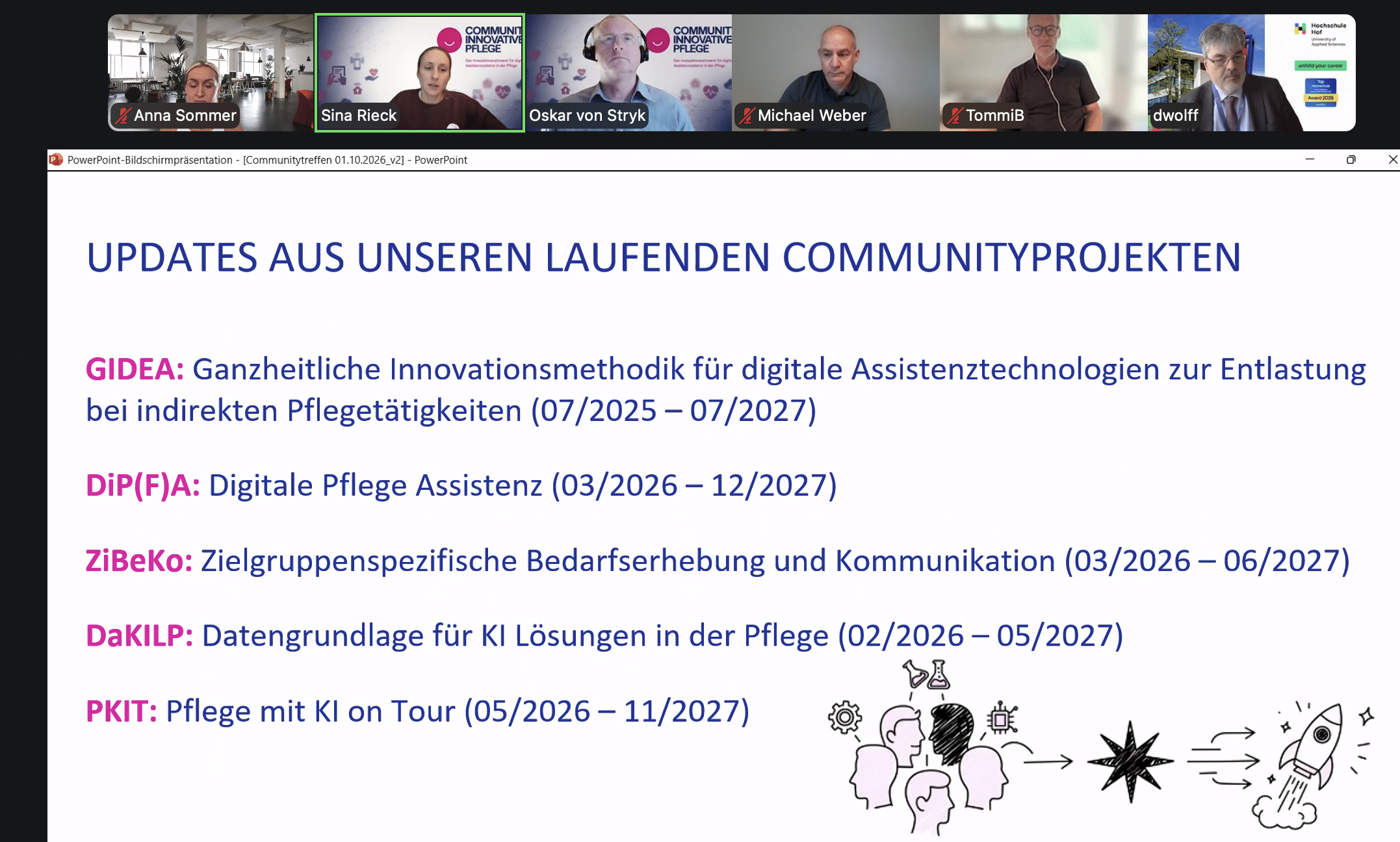
On 1 October 2026, the CIP community came together for its community meeting – and all five active projects shared their current progress. From nearly completed VR tests in Darmstadt care facilities to a growing number of digital care assistants, and an AI agent supporting nurses with voice-based documentation: the Community Innovative Pflege is gaining momentum – while simultaneously preparing for the third funding round.
All Five CIP Projects at a Glance
| Project | Project start | Current status (October 2026) |
|---|---|---|
| GiDeA | July 2025 | VR tests nearly complete; focus group interviews until end of October |
| DeePa – Digital Care Assistant | March 2026 | 3 care homes, 7 PADs, ~200 care episodes; telematics infrastructure connection in progress |
| ZiBeKo / Community Sprint (IU + Simon & Goetz) | March 2026 | Positioning finalised; website nearly complete; membership campaign launch end of October |
| DaKiLP | February 2026 | Prototype in development; 2nd Hackathon planned for February 2027 |
| Pflege mit KI on Tour | May 2026 | Data collection ongoing; multi-agent system in planning |
GiDeA: Nurses in Virtual Reality – and the Responses Are Surprising
The flagship project GiDeA – led by Frankfurt University of Applied Sciences, Fraunhofer IGD and the Caritasverband Darmstadt – is in the final phase of its VR testing. In four inpatient care facilities of the Caritasverband, nursing staff experienced a fully recreated care environment in virtual reality: they were given a genuine work task – such as assisting a robot during acute wound care – and were free to engage with it on their own terms.
Participant responses were consistently positive. Particularly striking: many nurses actively engaged with the topic of care robots in real-world contexts for the first time – far beyond greeting tasks or board games. The final focus group interviews are running in parallel and are expected to conclude by the end of October. The findings will feed into a digital assistance catalogue that evaluates care technologies on the basis of economic viability, care benefit and practical suitability. A follow-up project on the broader topic of “care maturity” is already in the application process.
DeePa: More Facilities, More Care Episodes, More Attention
The Digital Care Assistant project (DeePa) has significantly exceeded its original plan. The initial target was one care home, one outpatient service and at least four PADs – the team has reached three homes, seven PADs and a growing number of participating physicians. Two specially trained care professionals have carried out around 200 care episodes using the technology – covering ECG, blood glucose and blood pressure. Acceptance among nursing and care staff is high.
The team has been active in public communications: at Gesundheitsstadt Berlin, the ZI Congress in Berlin, in the Deutsches Ärzteblatt, and with an abstract submitted for the Deutschen Pflegekongress. A particularly encouraging development: an Indian delegation has expressed interest in the care model and wants to visit in person. The scientific evaluation has passed the ethics committee; data collection is underway. The biggest challenge remains the telematics infrastructure (TI) connection: currently only one facility is actively connected – a second is in preparation, while a third will likely never reach the TI. The team is working pragmatically on solutions.
ZiBeKo / Community Sprint: Positioning Complete – Membership Campaign Launches End of October
Our sub-project ZiBeKo – implemented by IU Internationale Hochschule together with Simon & Goetz Design GmbH – presented the results of its first project phase at the community meeting. Thomas Bayer (Simon & Goetz) reported: the target group identification and needs assessment for the inpatient and outpatient care sectors have been completed. From this, a well-founded positioning for the TIP (Technology and Innovation Platform for Care) has been developed – including service features, value propositions and a clear business model for the innovation community.
We are currently in the final stages of the third phase: the corporate design is complete, and a new website has been built together with Sina (TU Darmstadt). The membership campaign for the TIP launches at the end of October – a key milestone for the entire Community Innovative Pflege.
DaKiLP: Data Foundation in Place – Prototype for Diabetes Management in Development
The DaKiLP project (Data Foundation for AI Solutions in Care), led by Hochschule Hof and Diakonie Baden, is working on the use case of diabetes management and medication administration. Following the first hackathon, a process mapping exercise and a data transfer via the software provider, an AI-supported assistance system is now being developed and tested in a care facility.
The team is candid about the challenges: data quality in care documentation systems was lower than expected – high-quality software is often fed with sparse data, because the day-to-day reality of care leaves little time for thorough input. Missing standard interfaces make data access considerably more difficult. In response, a second large facility has been brought on board and various software providers are being compared. The second hackathon is planned for February 2027 – as the project finale, where participants will work hands-on with AI agents.
Pflege mit KI on Tour: Voice-Based Documentation – AI Agent Asks the Right Follow-Up Questions
With “Pflege mit KI on Tour”, Hochschule Hof brings a particularly practice-oriented approach to the community: nursing staff document via voice input – an AI agent structures, supplements and asks targeted follow-up questions when something is missing. The goal: structured, standardised data that can actually be processed further – not merely archived. Medical diagnosis by AI is explicitly excluded. The nurse reviews and confirms at the end – the AI agent supports, it does not replace.
Currently only four usable datasets are available – data collection continues. Next steps include capturing outpatient data and building a multi-agent system with interfaces to the primary care software and the TI messenger for communication with GP practices.
Outlook: Third Funding Round on the Horizon
As all CIP projects will conclude over the course of the coming year, the third funding roundis already in the starting blocks. Details will be presented at the next meeting, which will also provide more space for in-depth exchange and mutual feedback. We will keep you informed – here on this page and through our usual channels.
A heartfelt thank you to Sina and the entire TIP team at TU Darmstadt for the organisation, to all projects for their open and honest updates – and to the entire CIP community for collectively driving this important work for the digitalisation of care in Germany.
Frequently Asked Questions (FAQ)
What is the Community Innovative Pflege (CIP)?
The Community Innovative Pflege (CIP) is one of 20 selected innovation communities within the DATIpilot programme of the BMFTR. It receives funding of up to €5 million (duration 2025–2029) and brings together research institutions, universities and the care sector to develop and test digital solutions for care. It is coordinated by TU Darmstadt.
What does the ZiBeKo sub-project at IU do?
ZiBeKo stands for Zielgruppenspezifische Bedarfserhebung und Kommunikation (Target-Group-Specific Needs Assessment and Communication). The sub-project of IU Internationale Hochschule (Prof. Dr. Richard C. Geibel) and Simon & Goetz Design GmbH identifies the needs of different target groups in inpatient and outpatient care, develops a positioning for the TIP innovation community from these findings, and recruits members for that community.
What is the TIP and when does the membership campaign start?
The TIP (Technologie- und Innovationsplattform Pflege – Technology and Innovation Platform for Care) is the permanent innovation community that is to emerge from the CIP. It brings together actors from care practice, technology and research to promote digital care innovation in the long term. The membership recruitment campaign is expected to launch at the end of October 2026.
How can I get involved with the Community Innovative Pflege?
As a care facility, technology provider, health or care insurer, research institution or interested organisation, you can find out more about the CIP community and the TIP and join as a member. Please get in touch directly via the CIP project page at the E-Commerce Institute Cologne.
When is the next CIP community meeting?
The next date will be announced shortly. It will provide more space for in-depth exchange, mutual feedback and details on the third funding round. All members of the community will receive information through the usual TU Darmstadt channels.
Source: CIP Community Meeting, 1 October 2026, TU Darmstadt (Zoom). Community Innovative Pflege, DATIpilot programme of the BMFTR, FKZ 03DPC0212T. Further information: ecommerceinstitut.de/cip/
11. September 2026
CIP at ISPC 2026: First Project Findings Presented
Reading time: approx. 4 minutes
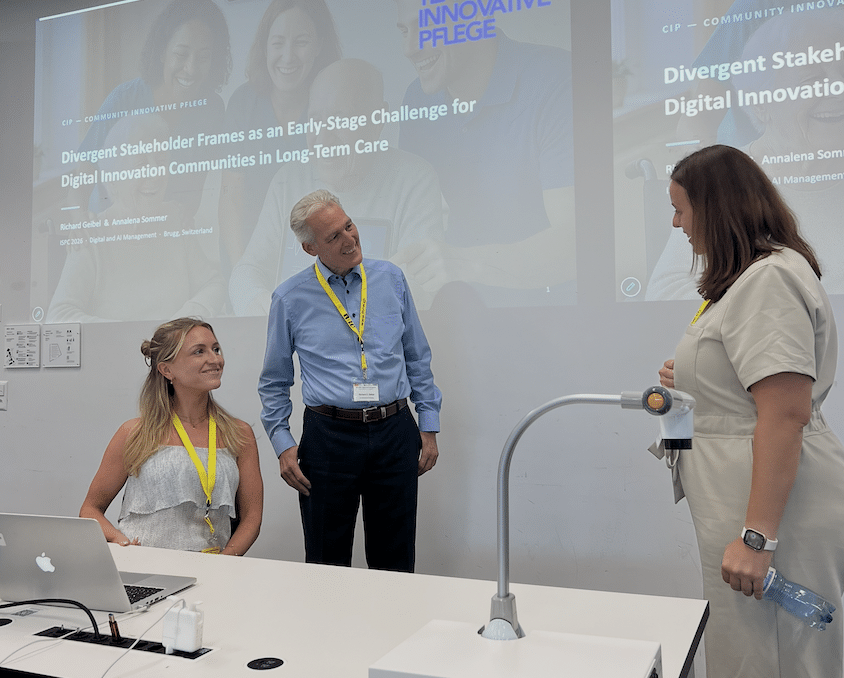
An important milestone for our project: our contribution “CIP — Community Innovative Pflege: Divergent Stakeholder Frames as an Early-Stage Challenge for Digital Innovation Communities in Long-Term Care” was accepted for the ISPC 2026 (International Scientific & Practical Conference) proceedings and presented on September 10 in the Scientific Track at FHNW in Brugg-Windisch.
What It’s About
At the center of our contribution is an observation from CIP’s early needs-assessment phase: digital innovation communities like ours rarely fail because of the technology itself — they fail because the organizations involved hold different assumptions about which problem they’re actually trying to solve. Drawing on our expert interviews with facility leadership, provider organizations, and technology vendors, we show what these divergent “frames” look like in practice — and what that means for how innovation communities in long-term care should be designed and managed.
Four Key Findings
- Shared problem understanding before technology selection – Before an innovation community can meaningfully decide on specific tools or platforms, it needs to be clear on which problem it’s actually trying to solve together.
- Same topics, completely different priorities – In CIP’s case: staffing shortages are the most pressing issue for facility leadership, yet they barely come up in interviews with provider organizations, even though both operate the same facilities.
- Not every level automatically represents the frontline – Whoever coordinates an innovation network cannot assume that umbrella organizations will automatically bring forward the operational concerns of frontline staff.
- A simple diagnostic trick – Topics that participants raise unprompted often reveal more about their real priorities than their answers to direct questions about those same topics.
What’s Next
The conference’s review feedback was thorough and constructive — very much in the spirit of ISPC’s motto, “Create Better Researchers.” A revision is optional, but we’re using the feedback as an opportunity to sharpen the paper’s methodological foundation for the final version, including a fuller methodology section and additional anonymized quotations from the interviews. The complete methodology and full findings will be presented in an accompanying academic publication.
We’re glad to put these early findings up for discussion beyond the project itself — and we thank the ISPC community for their valuable feedback.
31. August 2026
AI in Long-Term Care: A Practical Overview of Solutions Already Available
Reading time: approx. 4 minutes
One observation has come up again and again in our ZiBeKo conversations: many care facilities aren’t quite sure which AI-powered solutions already exist for long-term care – or which of them actually hold up in daily practice. So in this update, we’re sharing an interim snapshot from our ongoing technology research: an overview of AI approaches that are already in use in care settings, or well into pilot testing.
Voice-Based Documentation: voize as an Example
The most widely adopted AI application in German long-term care is arguably voice-based documentation. voize, a German provider, runs locally on the device: care staff speak freely, the AI structures what’s said and enters it directly into the documentation system. According to a Charité study, this saves an average of 39 minutes per shift – with over 1,800 facilities and more than 50,000 users currently active.
Image-Based Wound Recognition
An app photographs a wound, the AI identifies and classifies it automatically, and documents the results in a structured format. Several providers have since had their solutions approved as medical devices – an example of how AI in care has already arrived regulatorily, not just technologically.
Automated Fall Detection
AI-powered video systems with built-in privacy screening (such as SafelyYou) detect falls automatically and trigger both an alert and documentation, without staff needing to react manually. Widely adopted in the US already, comparable solutions in Germany are still mostly in the pilot phase.
AI Translation in Voice Documentation
An approach that came up particularly often in our interviews: care staff document verbally in their native language, and an AI translates automatically into German, routing the text to the correct documentation field. For facilities with internationally diverse teams, this is an intuitive fit – though how well it performs in practice varies considerably by setting, as our interviews show.
AI-Generated Conversation Summaries
Originally developed for doctor-patient conversations (e.g., Abridge, Nabla): the AI listens in and automatically produces a structured summary. A good example of how approaches from acute care could translate into long-term care.
What This Means for CIP
This overview is deliberately framed as ongoing research, not a final assessment. Exactly this question – which solution fits which facility, budget, and software environment – is one of the roles we see for CIP as an innovation community: offering neutral orientation in a market that’s hard for individual facilities to survey on their own.
Looking Ahead: Lunch Talk on “AI Sovereignty in Care”
This autumn, we’ll dig deeper into this topic in a lunch talk together with the CIP coordination team: which AI solutions already exist, what can they meaningfully be used for – and how do you recognize their benefits, limits, and risks? Details on the date to follow.
Do you know of AI solutions in care that we haven’t come across yet? Get in touch – we welcome every pointer.
17 July 2026
Quarterly Check-In: Exchange Among the Five Community Projects
On July 16, 2026, the quarterly check-in for the CIP community projects took place. During the event, all five projects presented their current status. In addition to ZiBeKo, these were GIDEA (Prof. Dr. Sergio Staab), DiPfa (Prof. Dr. Thomas Zahn), DaKILP and PKIT (both led by Prof. Dr. Dietmar Wolff).
The discussion focused on five key topics: the status of work completed to date, tangible practical impact and highlights, current challenges, collaboration with expert working groups and project sponsors, and next steps. This format ensures that the projects do not work in isolation but can learn from and support one another.
Communication Throughout the Project
A central element of CIP is a structured communication strategy that spans the entire project period. This involves defining targeted communication touchpoints—from the project’s start to well beyond its conclusion.
The process begins with materials for the website and LinkedIn. As the project progresses, touchpoints such as the publication of initial results, video interview formats, and event support follow—for example, for the planned lunch talk on AI sovereignty in nursing care. Toward the end of the project, best-practice documentation and knowledge transfer concepts will be developed. Long-term engagement is also planned after the official end of the project through mentoring, membership, and support for follow-up initiatives.
Next Steps in the Project
The July check-in has identified specific next steps for all community projects. By August 3, 2026, the projects will make their website materials available. This will allow initial results and project profiles to be published on the CIP website.
In addition, collaboration between the projects will be facilitated through shared SharePoint access. This close networking allows updates to be pulled directly from the projects—without manual forwarding. Content will be published only after final approval by the respective project teams.
The next quarterly check-in is scheduled for October/November 2026. In addition, the CIP office offers one-on-one meetings to all project teams to address individual needs and strengthen networking within the community.
28 June 2026
ZiBeKo: Field Phase Complete – First Findings from Nine Expert Interviews
Reading time: approx. 7 minutes | June 2026
The qualitative research phase of the ZiBeKo sub-project is complete. Over the past weeks, we conducted nine expert interviews with actors from both ambulatory and inpatient long-term care, as well as with a national-level industry association representative. In parallel, we produced an extensive secondary analysis on the role of statutory health insurance (GKV) and the Social Care Insurance (SPV) in financing digital transformation. This post shares our core findings for the first time — fully anonymised, in line with the confidentiality commitments we made to all participants.
Who We Spoke With
Our sample includes five ambulatory care services and four inpatient care facilities, complemented by one association perspective at the federal level. On the ambulatory side, the spectrum ranges from small rural care services with a few dozen clients to a large multi-site operator with more than 25 locations and an ambulatory-residential care model. On the inpatient side, we spoke with facilities of varying size and ownership structure — including denominational associations, diaconal institutions, and non-profit organisations — with capacities ranging from 86 to approximately 500 nursing home places.
At the leadership level, we spoke with care directors, facility managers, and one home manager. This breadth was methodologically deliberate: we wanted to capture not only the operational care perspective, but also the strategic management level responsible for investment decisions and technology adoption.
What the Field Phase Taught Us: Four Cross-Cutting Findings
1. The Bottleneck Is Not Technology — It Is Implementation
The most consistent finding across all nine interviews: the technological solutions to care’s most pressing daily challenges already exist. Voice-based documentation, AI-supported care planning, route optimisation, digital physician communication — all of this is technically available today. What is missing is not the solution. What is missing is structured support in getting these solutions into practice.
An ambulatory care director articulated this as clearly as one could: “The bottleneck isn’t what’s possible. The bottleneck is that not enough solutions are actually reaching practice.”
This pattern aligns precisely with what Rogers’ Diffusion of Innovations describes as the implementation gap: most facilities sit at the knowledge or persuasion stage — but the step towards actual adoption fails because of time constraints, budget pressure, a lack of IT competence, and insufficient training support.
2. Inpatient and Ambulatory Care — Same Drivers, Different Logics
Staff shortages, documentation burden, and financial pressure are shared across both settings. But the two systems follow fundamentally different operating logics — and this has direct consequences for what digitisation actually needs to deliver.
In ambulatory care, reimbursement is tied to individual care packages with defined time allowances. Time gained through digitisation is therefore immediately measurable and economically relevant. Documentation accounts for roughly 20 percent of a qualified nurse’s working time — not trivial, but manageable.
In inpatient care, lump-sum reimbursement applies. Here, qualified nurses spend 70 to 80 percent of their working time on documentation, according to multiple interviews — time not spent with the people they trained to care for. One facility manager put it plainly: “Qualified nurses are almost exclusively tied up with documentation. They only spend brief moments with residents.” A project partner responded dryly: “That’s a bit the wrong way round, isn’t it?”
For CIP, this means: ambulatory and inpatient facilities need similar tools, but fundamentally different arguments.
3. Acceptance Fails Because of Poor Rollout — Not Because of Resistance
Not one of our nine interview partners fundamentally rejected digital solutions. On the contrary — openness was widespread, and in some cases remarkable. Robotics, wearables, AI-assisted diagnostics: we encountered little in the way of resistance in principle.
What we did hear consistently: technology fails not because people are unwilling, but because rollout is poorly structured. One facility manager offered a formulation we now use internally as the acceptance formula: leadership buy-in × training support × system usability = acceptance. If any of the three factors is missing, adoption fails — regardless of how good the product is.
One case was particularly striking. A voice-based documentation app was rejected by roughly half of a facility’s staff — not because the speech recognition didn’t work, but because the app failed to automatically transfer the dictated insulin value into the medication management system. Staff had to enter the same data in two places. The facility manager’s verdict was direct: “It made things worse, not better.” This was not a technology problem. It was an integration problem.
4. TI Frustration Has Damaged Trust — Far Beyond the TI Itself
The mandatory connection to the Telematikinfrastruktur (TI) digital health network, required by 1 July 2025, left a striking pattern across several of our interviews. Facilities that formally completed the connection report persistent error messages, absent support, and a sense of having been left on their own. One facility has been dealing with an unresolved error code for over a year — a technician visited but could not fix the problem, and the vendor has not responded since.
What concerns us most about this: the frustration spills over far beyond the TI itself. A federal-level association representative framed it this way: “The Telematikinfrastruktur has unfortunately cast a very negative shadow over digitisation as a whole.” Facilities that were disappointed once approach the next digitisation initiative with far more caution — and sometimes with outright reluctance.
Findings by Segment: A Summary
Beyond these cross-cutting findings, we documented specific results for each of the four segments our analysis covers.
Ambulatory Care — The most urgent issue is not technology, but implementability. Plug-and-play is not a marketing phrase here — it is a genuine operational requirement. Systems must work immediately, without complex configuration. Route planning remains largely manual in many services. Family communication is a chronic time drain for which technical solutions exist but are not used, because costs are considered disproportionate. And small ambulatory services without their own IT capacity structurally cannot unlock the potential of digital systems on their own.
Inpatient Care — Documentation dominates the daily work of qualified nurses. The new personnel benchmarking instrument (PeBeM) is reshaping staffing structures, but has not yet been fully implemented everywhere. The household community model — small resident groups with dedicated daily companions rather than large ward corridors — is described as a promising approach that creates new digitisation demands. Large care organisations have begun establishing internal AI departments as institutional innovation channels. This structure is absent in smaller providers — and is precisely the gap that CIP could fill.
Association and System Level — At the federal level, a picture emerges across hundreds of member organisations: roughly 10 percent of facilities still document on paper, around 60 percent are partially digitised, and approximately 30 percent are advanced — though this last figure may be optimistic. The existing digitisation subsidy mechanism under § 8 para. 8 SGB XI is expiring. New funding pathways from the planned Care Reorganisation Act (PNOG, draft published June 2026) are in sight, but not yet enacted.
Statutory Health Insurance and Social Care Insurance (GKV/SPV) — Since we did not conduct our own interviews with insurance representatives, we present this segment as a research and analysis document rather than an empirical results document. The core finding: GKV (health insurance) and SPV (care insurance) are structurally separate systems with separate budgets and separate negotiation logics — a distinction that frequently gets blurred in public debate. The SPV is in deep financial crisis: a 667 million euro deficit in the first quarter of 2026 alone, despite receiving a federal loan. In practice, there is no longer room for supplementary reimbursements for digitisation in care fee negotiations. At the same time, the SPV has funded concrete digitisation pilots, including a telecare model programme (12 projects, concluded end of 2025). The paradox: insurers want digitisation, but cannot finance it through reimbursement mechanisms. The planned PNOG digital investment fund (€1.6 billion) is a potential turning point — but only for ambulatory and partial inpatient facilities. Fully inpatient care homes are excluded.
What This Means for CIP
Our field phase has sharpened three roles for CIP as an innovation community, which we are now incorporating into our transfer models.
First: Technology orientation and curation. Facilities often do not know which solution fits their context. A neutral, filtered orientation offer — matched to facility size, budget, software environment, and interoperability requirements — would address a genuine gap.
Second: Plug-and-play implementation support. Solutions need to arrive pre-configured, pre-tested, and accompanied by training materials. “Like a smartphone — you buy it, switch it on, install the app, and it works” — that was how one of our practice partners described the ideal. CIP can provide this function for facilities without their own technical infrastructure.
Third: Funding navigation. The planned PNOG digital investment fund will remain out of reach for many ambulatory facilities if the application bureaucracy defeats them. “Here comes another funding application — we all know what those look like. It dies right there” — a comment from one of our conversations that captures the risk precisely. CIP can serve as a navigator.
What CIP should not be, we heard just as clearly: not another network that talks. Not a local platform that triggers competitive thinking. Not a pilot project that burdens facilities with effort rather than relieving them.
What Comes Next
Qualitative analysis will be completed in the coming weeks. Four structured results documents — covering ambulatory care, inpatient care, the system level, and technology providers — form the basis for the subsequent quantitative phase, in which we will validate our findings with a broader sample.
We will pay particular attention to the structural differences between ambulatory and inpatient settings — not only in terms of needs, but also regarding communication channels, decision-making logics, and funding access. An innovation community for care that takes both settings seriously must address them differently, support them differently, and make its case differently.
If you have practical experience from care settings to share, or can point us to relevant contacts: we welcome every perspective. Write to us at info@ecommerceinstitut.de.
22 May 2026
CIP at the IU Students Symposium Health: First Results, Four Approved Projects — and What We Learned
Reading time: approx. 5 minutes
On May 22, 2026, we presented Community Innovative Pflege (CIP) and our sub-project ZiBeKo to a broader university audience for the first time at the 3rd IU Students Symposium Health in Cologne. The goal was not just visibility — it was genuine exchange. Because care innovation only works when the people who will shape healthcare and research tomorrow are part of the conversation.
This post summarises what we presented — and the questions the discussion raised.
Why CIP? The Starting Point.
Any honest conversation about care innovation has to start with reality — and the reality is sobering.
157,000 care workers are projected to be missing by 2040. 71 percent of those currently working in care do not expect to remain fit for work until retirement. In international comparisons of healthcare digitalisation, Germany ranks 16th out of 17. And 95 percent of care professionals say that policymakers have not genuinely understood the problems facing the sector.
These are not four separate problems. They describe one and the same structural deadlock: an industry under extreme pressure, whose digitalisation is stagnating — and where solutions rarely emerge where the problems are actually lived.
That is precisely where CIP comes in.
What Is CIP — and Why Is It Different?
Community Innovative Pflege (CIP) is an interdisciplinary innovation community that brings together technological, care-practice and social expertise. Its goal is not to design user-centred solutions at a desk, but to develop and test them together with the practitioners who work in care every day.
CIP was selected from 480 applications as one of 20 consortia in the DATIpilot programme of the Federal Ministry for Research, Technology and Space Affairs (BMFTR), and receives funding of up to €5 million for the period 2025–2029. The consortium is led by Team Innovative Pflege e.V. (TIP e.V.).
How CIP Works: Community-Sprint Logic
CIP’s working method follows a clear logic — not top-down, but driven from within the community itself.
Step 1 — Build the community. Member assemblies, specialist working groups, active presence at sector events including DMEA, Altenpflege and ProCare.
Step 2 — Survey needs. Target group analysis and interview studies through our sub-project ZiBeKo — practitioners identify where the real pinch points are.
Step 3 — Fund projects. Two funding calls per year for community projects: up to €300,000 per project, maximum duration two years.
First Results: Four Projects From 17 Submissions
The first funding round demonstrated strong interest — and strong quality. Of 17 submissions, 7 were shortlisted for a vote and 4 projects were approved. The CIP starter project itself is an additional fifth initiative.
The four approved projects:
A — CareTechSelect. A dynamic online catalogue of digital assistance systems for care — complemented by a mixed-reality application that allows care workers to realistically assess the relief potential of digital systems before a purchasing decision is made.
B — DAKILP. A public-interest data foundation for AI solutions in nursing care, developed with Caritas, Diakonie, VdDD and Hochschule Hof. Without valid data, there are no valid AI models — DAKILP creates the foundation.
C — DIPA. Digital Care Assistance: AI-supported initial assessment at the point of care for rural regions. Fewer unnecessary hospital admissions, less communication overhead, more time for actual care.
D — PflegeKiontour. AI-supported process digitalisation in wound management for both ambulatory and inpatient care — developed with C&S and Hochschule Hof.
Our Contribution: The ZiBeKo Sub-Project
As the scientific sub-project of IU International University of Applied Sciences at the E-Commerce Institut Cologne, we provide the empirical and theoretical foundation for CIP: ZiBeKo — target group identification, needs assessment and communication concepts.
Our desk research is structured across five sequential blocks:
- Block A — Care landscape: Structural baseline, figures and trends. Sources: Destatis, RWI Care Home Rating Report, Bertelsmann Foundation, DAA follow-up study 2022.
- Block B — Digitalisation: Current state of digital applications, funding programmes and regulatory frameworks.
- Block C — Target group needs: Segment-specific studies for each of our seven target group segments — from facility directors and ambulatory care managers to software providers and health insurers.
- Block D — Competition and benchmarks: International best practices including Buurtzorg (Netherlands) and Scandinavian care models; positioning relative to other DATIpilot communities.
- Block E — Theoretical grounding: Technology Acceptance Model (Davis), Diffusion of Innovations (Rogers), Community of Practice (Wenger) — three frameworks that precisely describe how innovations actually land in complex organisations.
Three Findings That Surprised Us
Three conclusions emerged from the desk research that significantly sharpened our hypotheses ahead of the interview phase.
01 — Acceptance is a process problem, not a technology problem. There are tools. There is funding. There is demand. What is frequently missing is structured onboarding and change management support — the implementation gap that Rogers’ diffusion theory describes precisely. This is the most important implication for project development within CIP.
02 — The most desired technologies are the least common ones. 47 percent of care workers want speech recognition for documentation; 42 percent want mobile devices. At the same time, over 80 percent of facilities report that exactly these solutions are barely implemented. The gap between wish and reality is not technical — it is structural and organisational.
03 — Regional differences are structural, not cosmetic. Eastern Germany is hit twice: a declining labour force potential meets sharply rising demand. We have refined our interview sampling along four axes — region, care setting, facility size and type of provider — to reflect this.
What Comes Next
The presentation at the IU Students Symposium was also an invitation: anyone working in care, research or at the intersection of technology and healthcare is warmly encouraged to get in touch.
Our next steps:
- Field phase: Interview series with ambulatory care services, frontline care workers, software providers and health insurers — already underway.
- 2nd funding round: Seven thematic priorities are ready — from real-world labs and interoperability (ePA, TIM) to care digitalisation maturity frameworks.
- Publications: Contributions to the 6th ISPC 2026 at FHNW in Switzerland and the 7th ISPC 2027 are in preparation — both appearing as Springer Nature Proceedings.
More about the project: innovativepflege.de
Questions, ideas or interest in being interviewed? Get in touch directly: annalena.sommer@iu.org
14 May 2026
ZiBeKo: Methodology & First Insights into Care Innovation
Reading time: approx. 5 minutes
Over recent weeks, we have laid the groundwork for the scientific work in our ZiBeKo sub-project: a systematic desk research that maps the German care landscape, the state of care digitalisation, and the needs of our target groups. As a sub-project of Community Innovative Pflege (CIP) within the BMFTR’s DATIpilot programme, we are providing the empirical and theoretical basis for the upcoming field phase with stakeholder interviews from care practice, research, and industry.
This post offers a look into our methodological approach — and shares first insights that have sharpened some of our assumptions and surprised us with others.
Why desk research before field research?
Before we go into depth with care professionals, facility managers, or health insurers, we need to know what we are talking about. A robust needs assessment in practice-oriented care research builds on existing data — otherwise one risks asking questions whose answers have long been documented, or duplicating existing studies instead of using their findings as a springboard.
Our desk research therefore pursues three goals:
- to structurally understand the care landscape — who is who, how is it organised, where are the tensions
- to capture the current state of care digitalisation — what is working, what is stuck, what is missing
- to sharpen our interview questions empirically and theoretically — so that we don’t ask blindly in the field, but close gaps systematically
Our methodology: Five blocks, one logic
We structured the desk research in five interlocking blocks.
Block A — Understanding the care landscape. Structural basis: numbers, distributions, trends. Key sources: care statistics from the Federal Statistical Office (Destatis), the RWI Essen care home rating report, the Bertelsmann Foundation’s care infrastructure study, and the DAA follow-up study 2022.
Block B — Digitalisation in care. Status quo of digital applications, funding programmes, and legal frameworks. In focus: DAA studies 2017 and 2022, position papers from the digitalisation-in-care alliance, digital care applications under § 40a SGB XI, mandatory connection to the telematics infrastructure (TI) since 1 July 2025, and the BMFTR’s “Pflegeinnovationen 2030” programme.
Block C — What moves the target groups. For each of our seven target group segments — from facility managers and outpatient care managers to software providers and health insurers — we reviewed segment-specific studies, industry reports, and needs surveys.
Block D — What already exists. Which innovations, initiatives, and funded projects are already in place? What can we learn from international best practice such as Buurtzorg in the Netherlands or digitalised care in Scandinavia? Where do we complement other DATIpilot communities and the Cluster Zukunft der Pflege?
Block E — Theoretical foundation. As a scientific sub-project, we anchor our needs assessment theoretically. We draw on three classics that describe precisely what a care innovation community such as CIP is currently living: Davis’s Technology Acceptance Model (1989) for care technology acceptance, Rogers’s Diffusion of Innovations (2003) for how new solutions spread within organisations, and Wenger’s concept of Communities of Practice for shared learning across practice communities.
First insights: What we found
We expected the care landscape to be under pressure. We did not expect how systematically and unanimously this diagnosis is documented.
The pressure is real and measurable. Three quarters of care professionals regularly work under high time pressure, and 71 percent do not expect to be able to work until retirement — compared to 42 percent in the general population (DAA follow-up 2022). Forecasts project a shortfall of 157,000 care professionals by 2040. The Bertelsmann study adds: no German district is expected to be spared from staffing shortages, with eastern Germany hit twice over — declining labour force potential meets sharply rising demand.
Digitalisation is progressing — but unevenly. Over 80 percent of facilities state that digitalisation has only been partially, hardly, or not at all implemented at their site. At the same time, the willingness is there: 47 percent of care professionals want voice recognition for documentation, 42 percent want mobile devices. The most desired technologies are precisely the least widespread. Germany ranks 16th out of 17 in international digitalisation comparisons.
The perception of policymaking is unambiguous. 95 percent of surveyed care professionals believe that politics has not understood the problems of the care sector — a figure that confirms our approach: a care innovation community like CIP starts not from the top, but with those who deliver care every day.
The outpatient market is large and under pressure. At the end of 2024, 17,769 outpatient care services were providing care to around 2.2 million patients — the number of services rose by 2.2 percent in 2024. Notably, providers are shifting investment from personnel to digitalisation because staff cannot scale. At the same time, financing rules for many digital innovations are still missing.
CIP does not stand alone, but in its own place. We are one of 20 consortia selected from 480 applications in the DATIpilot programme, with up to five million euros in funding for 2025–2029. Alongside us, the Cluster Zukunft der Pflege (BMBF, 2017–2029, phase 2), the telecare model programme under § 125a SGB XI, and international references such as Buurtzorg are also active. Where the cluster works technology-centred and scientifically, CIP is community-oriented and practice-driven — the two complement each other rather than competing.
What this means for the field phase
We draw three methodological consequences from these findings.
First, we have sharpened our sampling. The regional differences between East and West, urban and rural, are not cosmetic — they reflect structurally different starting points, as the Bertelsmann data show. We select our interview partners along four axes (region, setting, size, ownership) so that outpatient and inpatient digital care are captured from multiple perspectives.
Second, we have revised our interview guide. New probes on TI connection, DiPA under § 40a SGB XI, and voice recognition close gaps that had not been clear to us before. Acceptance questions now explicitly follow the logic of the Technology Acceptance Model — with items on perceived usefulness and ease of use.
Third — and perhaps most importantly — we enter the field with a sharpened hypothesis: care technology acceptance is often less a technology problem than a process problem. The desk research shows: there are tools, there is funding, there is demand. What is often missing is structured introduction and ongoing support — the “implementation gap” that Rogers’s diffusion theory describes precisely.
What comes next
In the coming weeks, we are continuing the interview series we started with our first conversation in Heidelberg. Focus: outpatient care managers, operational care professionals, software providers, and health insurers. After that, the quantitative phase will broadly validate the qualitative findings.
In our view, meaningful care innovation in Germany only succeeds when it is developed close to practice — and when voices that are rarely heard get a seat at the table. If you want to contribute your own experience or point us to relevant sources, you are warmly invited. More about the project on our project page.
Do you know studies, practice insights, or contacts we should be aware of? Get in touch — we welcome every perspective we may have missed so far.
28 April 2026
Community Innovative Pflege: Moving Forward – Update April 2026
Reading time: approx. 3 minutes
In mid-April 2026, the digital general assembly of Community Innovative Pflege (CIP) sent a clear signal: the community is growing, its structures are holding – and momentum is building.
New Board, Continued Mission
On 16 April 2026, the board of Team Innovative Pflege e.V. (TIP e.V.) was newly confirmed. Ansgar Funcke (Board Member, Caritasverband Düsseldorf) takes on the role of 1st Chair. Dr. Christoph Günther (Co-Founder, Awesome Technologies) was confirmed as 2nd Chair, with Stefan Wesarg (Fraunhofer IGD) completing the board. Prof. Dr. Oskar von Stryk (TU Darmstadt) was re-elected and remains Speaker of the CIP Management Team.
Warm thanks go to outgoing board members Michael Weber and Florian Kirchbuchner, who guided the association through its founding and early growth phases.
Four Projects Moving into Implementation – Including ZiBeKo
Four community projects from the first CIP funding call are now entering active implementation:
- DaKILP – Data foundations for AI solutions in nursing care, including an AI hackathon
- DiPFA – AI-supported nursing assistance in rural Vorpommern
- ZiBeKo – Needs assessment and communication concepts for the innovation community
- PflegeKIonTour – AI-supported wound management via TI-Messenger and interoperability standards
ZiBeKo forms the foundation of this work: we are systematically identifying what care actors truly need – and how they can best be reached. The desk research phase is complete and first interviews are underway.
Second Funding Call Is Live
Immediately following the general assembly, the second CIP funding call was approved and launched. Consortia are sought to bring digital assistance systems into nursing practice – across three formats: Community Sprint, Practice Sprint, and R&D Project. Up to €300,000 per project is available.
If you work in nursing, research, as a payer, or as a technology provider: now is the right time to get involved.
CIP at Major Industry Events
The community was also present in person this week at two of the sector’s key gatherings:
- DMEA, 21 April 2026 – Hall 2.2, Stand A107 (Bayern innovativ / C&S)
- Altenpflege Trade Fair, 22 April 2026 – Hall 6, Stand A118 (diagtus.care)
Outlook: TIP Symposium 2026/2027
The first TIP Symposium is in preparation – planned for Q4 2026 or Q1 2027. Two days, nationwide, covering the topics shaping nursing care today. Interested speakers and attendees are welcome to get in touch now.
For more information on CIP, the funding call, and the working groups, visit the TIP website and LinkedIn page.
17 April 2026
CIP Member Meeting April 2026: Looking Back and Heading Into Round Two
Reading time: approx. 4 minutes
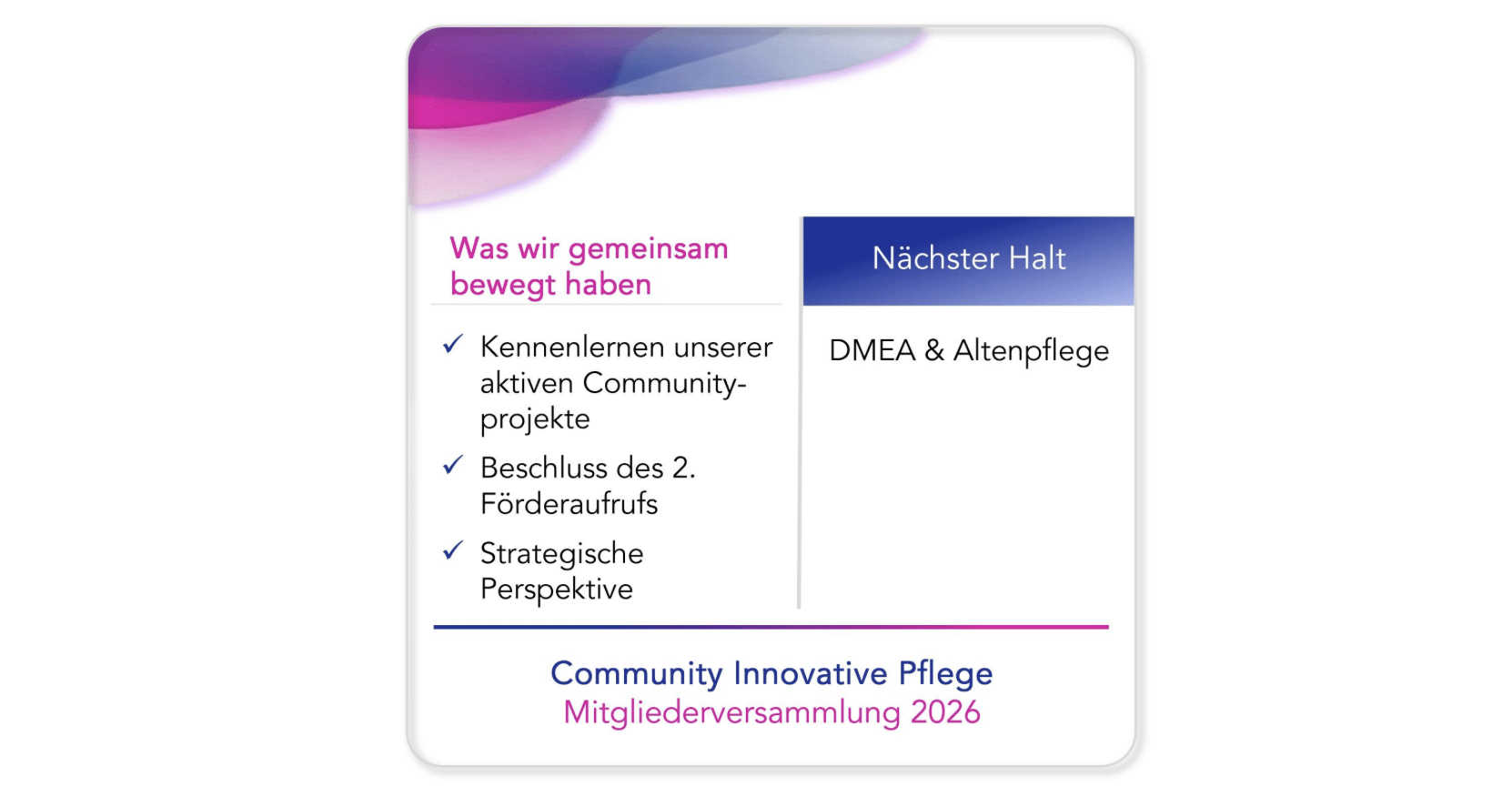
On 16 April 2026, the Community Innovative Pflege (CIP) came together for its digital member meeting. Alongside around 30 participants from nursing practice, research, and industry, our ZiBeKo team reviewed the past year, discussed the results of the first funding round, and helped sharpen the topics for the second round.
An intensive morning – here are our key takeaways.
Looking Back at 2025 and Q1 2026: A Solid Foundation for Nursing Innovation in Germany
The past year was marked by tangible growth. The community has visibly connected with policymakers, professional associations, and other DATIpilot communities. Team Innovative Pflege e.V. also welcomed new members.
Key milestones in the digitalisation of nursing care include:
- Launch and relaunch of the website innovativepflege.de
- Building a LinkedIn presence
- Kick-off of the technical working groups (Facharbeitsgruppen, FAGs)
- Start of a total of five community projects
The team was also present at major industry events: the DATIpilot community meeting in Leipzig (October 2025), ProCare Hannover (February 2026), the admission of the Caritas associations of the Diocese of Mainz, and the DaKILP hackathon (February 2026). A strategy workshop in February set the course for what comes next – and today the preparation of the second project call was finalised.
Results of the First Funding Round: Four Projects + Starter Project
The selection process was structured and transparent. Of 17 submissions, 10 were not endorsed due to insufficient fit, 7 were admitted to the vote, 4 received a funding recommendation – and all 4 were approved. In addition, CIP is running its own starter project.
The starter project is building a dynamic, care-appropriate online catalogue for digital assistance systems, including a built-in evaluation system (CareTechSelect). It is complemented by a Mixed Reality application that lets nursing staff realistically assess the workload-relief potential of digital assistance systems.
The three other funded projects at a glance:
- DaKILP – Data foundation for AI solutions in nursing: a public-interest data base, process-oriented use cases, and tested AI prototypes. Partners include Diakonie, Caritas, Hof University of Applied Sciences, FINSOZ, and the Data Science Institute.
- DiPA – Digital Nursing Assistance: cutting roughly 60 minutes of daily coordination effort via AI-supported assessments at the point of care, DIHVA systems, and modern mobile diagnostics (digital otoscopy, stethoscopes, 6-lead ECG).
- Pflegekontour: AI-supported process digitalisation for wound management in both outpatient and inpatient nursing care – with Hof University, Awesome Technologies, Audience.AI, and C&S.
Current Status Q2/2026: Research and Practice in Dialogue
The starter project is currently in qualitative evaluation of focus groups and expert interviews with nursing staff from five facilities. Core questions: the burden of indirect nursing tasks and expectations toward digital assistance systems as workload relief.
In parallel, teams are developing the online catalogue and the MR application. From September 2026, initial results will be presented to nursing staff – for direct feedback and further iterations.
The approach is deliberately highly participatory: nursing staff are not only the target group, they are co-designers. That creates transparency in technology assessment and lays the groundwork for the association’s upcoming “nursing maturity level” (Pflegereifegrad) – an important building block for broader acceptance of nursing technology in the field.
Second Funding Round: These Topics Are in Focus
For the second funding call, the CIP management team has prioritised seven thematic areas:
- Digital nursing & real-world labs
- Technology integration
- Pilot study on assistance systems
- Nursing data use & the European Health Data Space (EHDS)
- Interoperability & scaling (e.g. ePA, TIM)
- Classification & maturity level
- Process-innovation guidelines
The selection criteria remain clear: projects must contribute to digital assistance systems, involve at least two of the three stakeholder groups (nursing, research, industry), stay below the maximum funding amount of €300,000, and be completed by the end of 2028. The technology readiness level is typically TRL 6–7.
Our View from the ZiBeKo Team
For us as the ZiBeKo subproject (target-group-specific needs assessment and communication), the meeting was a real tailwind. It underlined how much nursing innovation in Germany depends on a dialogue that takes nursing professionals seriously. That is exactly what we are working on – through our ongoing interviews in inpatient care (starting March 2026 in the Heidelberg region) and our completed desk-research blocks A–E.
Join In
Will you be at DMEA on 21 April in Berlin or at the Altenpflege trade fair in Nuremberg? Come and connect – CIP is organising networking events on site, including a networking dinner on DMEA Tuesday around 19:30.
You can find more on our work on our ZiBeKo project page and in our kick-off blog post. Questions, ideas, or collaboration interest? We would love to hear from you.
1 April 2026
Project Launch ZiBeKo: Kick-off of Community Innovative Care in Cologne
We are officially up and running – the kick-off for the ZiBeKo (Target Group-Specific Needs Assessment and Communication) project has taken place and the project is now underway. As a sub-project of Community Innovative Care (CIP), we are working within the DATIpilot programme of the German Federal Ministry for Research, Technology and Space (BMFTR) to build a sustainable innovation community for the care sector.
At the joint kick-off meeting, all sub-projects of the CIP community came together for the first time. For the ZiBeKo consortium, this meant that practice partner Simon & Goetz Design GmbH & Co. KG from Frankfurt and research partner IU International University of Applied Sciences at the Cologne campus aligned on collaboration structures, responsibilities and the milestone plan for the months ahead.
At the core of the Community Sprint is the question of whether and how diverse stakeholder groups from inpatient and outpatient long-term care can collaborate on digital innovations – and how they need to be reached and engaged to form a functioning innovation community.
Our next steps by 30 April 2026:
- 📋 Feedback survey on the selection and application phase (deadline: 10 April 2026)
- ✍️ Code of Conduct – sign and submit the shared principles of collaboration
- 📄 Project fact sheet – review, finalise and submit together with visual materials, logo and slogan
- 📅 Quarterly check-in – schedule a 30-minute regular exchange for all project members
- 👥 Responsibilities – define and communicate roles and contact persons within the team
All working documents – including the kick-off presentation, Code of Conduct and the official communications kit with DATIpilot and BMFTR logos – are available to the project team via Nextcloud. A central networking platform for all CIP sub-projects is currently being prepared.
For more information about the Community Innovative Care initiative: www.innovativepflege.de