eCommerce Returns in 2026: How Green Nudges and AI Are Transforming the Culture of Sending Back
Abtract: Germany is Europe’s returns capital: more than 530 million parcels are sent back every year, and in fashion retail the return rate reaches as high as 50 per cent. The environmental and economic costs are enormous. Yet a new approach rooted in behavioural economics shows that carefully designed psychological prompts – known as Green Nudges – can reduce return rates by up to 18 per cent without dampening the willingness to buy. The E-Commerce Institute Cologne identifies this data-driven method as one of the most powerful levers for more sustainable and more profitable online retail in 2026.
Important Facts about Returns and Green Nudges in eCommerce
- 530+ million parcels were returned in Germany alone in 2021 (Statista / University of Bamberg).
- Germany has the highest share of return users in all of Europe, at 56 per cent.
- In fashion retail, return rates reach up to 50 per cent – largely driven by ordering multiple sizes.
- 87 per cent of the top 100 German online shops still offer free returns.
- Almost 4 per cent of all returned items are destroyed and cannot be resold as new.
- AI-powered Green Nudges by behamics draw on 40+ psychological mechanisms to cut returns by up to 18 per cent.
- The German Federal Environment Agency estimates packaging savings alone at 180,000–370,000 tonnes per year.
- Environmental awareness as a nudge factor is expected to grow in effectiveness as consumer eco-consciousness increases.
What Are Green Nudges? Behavioural Economics in the Service of Sustainability
The term „nudge“ originates in behavioural economics and was popularised by Nobel Prize-winning economists Richard Thaler and Cass Sunstein. A nudge is a carefully designed prompt that steers people towards a particular decision without forcing them or using financial incentives. The gentle push in the right direction works by changing the way a choice is presented, not the choice itself.
Green Nudges apply this principle to environmentally sustainable behaviour. They activate at the precise moment a decision is being made – at checkout, during product comparison, when selecting a delivery option – and guide behaviour softly towards a more eco-friendly outcome. Typical psychological mechanisms include Social Norms (“Most customers choose size M”), Loss Aversion (“Avoid unnecessary return costs”), and Environmental Framing (“Your choice saves X grams of CO₂”).
Crucially, Green Nudges are not prohibitions or hidden manipulation. They change the decision environment while leaving freedom of choice entirely intact. This makes them legally sound, ethically defensible – and, according to current research, surprisingly effective. Studies show that well-designed nudges can influence behaviour in certain contexts as strongly as classic price incentives, but without the negative impact on purchasing intent.
In an eCommerce context, Green Nudges are particularly valuable because the entire purchase journey is digital and therefore fully measurable. Every interaction can be analysed, every nudge refined. Combined with Artificial Intelligence, this creates a system that no longer delivers one fixed message to all users, but instead learns individually which psychological lever works best for which customer profile.
The Problem: Convenience at the Cost of Climate and Cash
Returns have become a baseline expectation in German online retail. Free returns have been a competitive tool for years: nearly nine in ten of Germany’s largest online shops offer them at no cost. But what is convenient for consumers causes substantial damage on the business and environmental side.
Particularly problematic is the practice of bracketing: customers order the same product in two or three sizes, try them on at home, and send the rest back. This behaviour is widespread in fashion and drives return rates to as high as 50 per cent. Every returned parcel means additional transport mileage, processing effort, packaging waste – and in roughly four per cent of cases, the outright destruction of the item.
The economic dimension is equally serious. A single return costs retailers between €5 and €20 depending on the product and category. At double-digit return rates, the free-returns policy quickly becomes a zero-sum game – or worse, loss-making.
Solution: Green Nudges and AI as Tools for Behaviour Change
The approach presented here was developed by behamics, a Swiss software company that combines behavioural economics with Artificial Intelligence. The idea is straightforward: rather than making returns more expensive or restricting them outright, the system gently steers purchasing behaviour in a more sustainable direction at the exact moment a decision is being made.
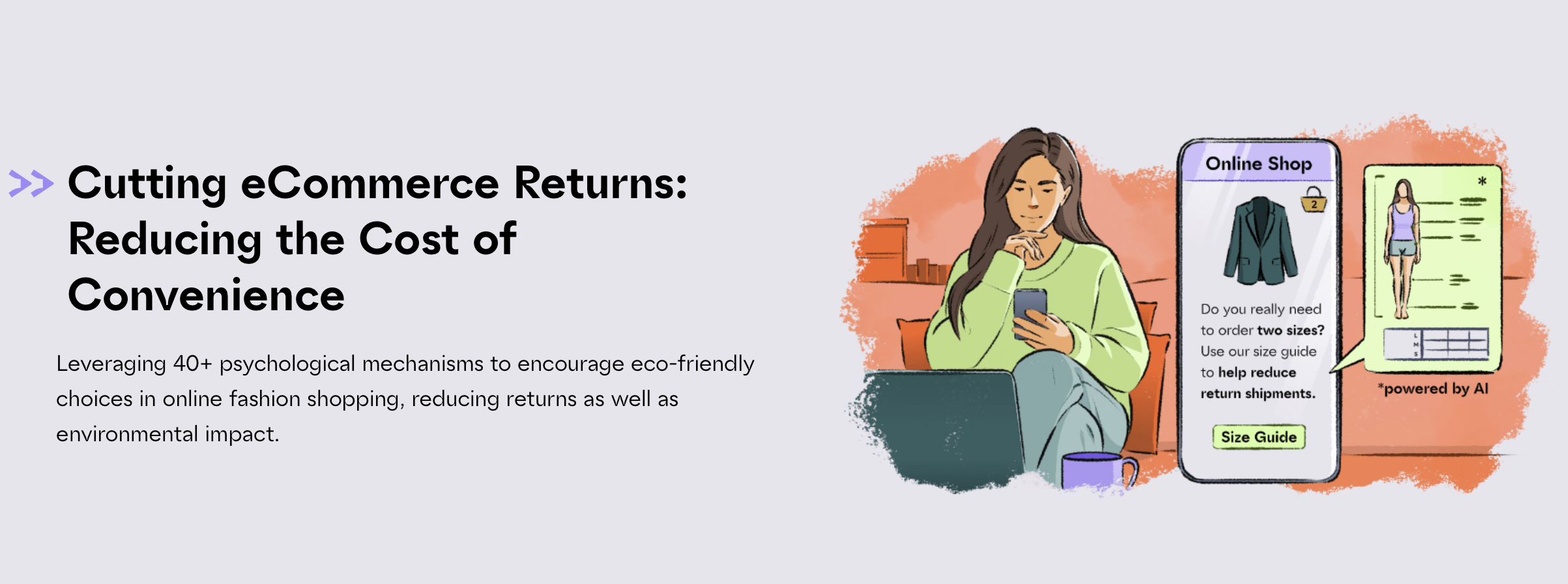
In practice, the AI detects when a customer adds multiple sizes of the same item to their cart. At that moment, a personalised pop-up appears highlighting the environmental cost and encouraging the customer to use the size guide to choose the right fit. The message is not preachy – it appeals to shared responsibility. A representative example reads roughly: does the customer really need two sizes, and by choosing the right one upfront using the size guide, unnecessary return journeys can be avoided together.
What sets the system apart is its range: the AI selects from more than 40 psychological mechanisms – including Social Norms, Loss Aversion, Environmental Impact and Time Loss – the one most likely to resonate with a given user profile. The result is a personalised nudge rather than a one-size-fits-all message.
Expert Quote
These nudges help reduce unnecessary returns by encouraging customers to use size guides and product information to select the appropriate size. As environmental awareness grows, these nudges are expected to become even more effective.
— Dr. Thilo Pfrang, Founder & CEO, behamics | Wiebke Brinner, Behavioural Scientist, behamics
Strategy Comparison: Approaches to Reducing Returns at a Glance
| Measure | Mechanism | Return Reduction | Effort |
| AI-powered Green Nudges | Social norms + loss aversion | up to 18 % | Low (SaaS) |
| Interactive size advisor | Product info + AR | 10–15 % | Medium |
| Return fee | Economic incentive | 5–12 % | Low |
| Authentic customer reviews | Social proof | 8–10 % | Low |
| 360° / video product views | Reality proximity | 6–8 % | High |
Table: E-Commerce Institute Cologne, own analysis 2026. Return reduction figures are indicative values from practical studies.
About Green Nudges: Psychology Meets Sustainability
The approach presented in this article originates from Green Nudges – an initiative that systematically documents how behavioural-economic prompts can foster environmentally sustainable behaviour. Their platform serves as a knowledge hub and practical archive: real-world Green Nudge projects from a variety of industries and countries are collected, analysed, and made accessible for broad application.
The E-Commerce Institute Cologne thanks the team for sharing their content, and recommends that retail businesses, looking to make sustainable changes with a data-driven-approach, explore a collaboration with the consulting.
Academic Context
Research by Julian Thiers and the team led by Prof. Dr. Richard C. Geibel at the E-Commerce Institute Cologne shows that the returns problem in German eCommerce is not an unavoidable structural feature, but a behavioural economics phenomenon. Understanding the psychology behind impulse purchases and bracketing enables businesses to influence buying behaviour in an ethically sound way – without undermining the incentive to buy.
The Green Nudge approach is more than a sustainability instrument: it is also a profitability lever. Reducing return rates by five percentage points can translate into six-figure annual savings for mid-sized online retailers. Companies that integrate this approach early into their UX and checkout flow secure a dual advantage: greater economic efficiency and a credible sustainability positioning vis-à-vis an increasingly discerning consumer base.
The nudging principle draws on an established scientific framework: people do not make decisions rationally, but contextually. Change the context at the right moment, and you change the behaviour – sustainably and at scale.